Miami River Quality Action Team
Annual Report 1998-1999
Marine Safety
|
PROBLEM: Year 2000 associated technology breakdowns will
have a harmful effect on commerce and port safety on the Miami
River.
The Year 2000, or Y2K, dilemma threatens wide scale disruption
to our daily lives and livelihoods. The heart of the problem
is that solid state circuit and computer program designers designed
both hardware (circuit board components) and software (computer
programs) with only a two place numeric data field for the year.
As we roll into the year 2000, it is feared that many solid state
controlled systems and computer programs will fail to some degree
unless the two place numeric year data field has been converted
into a four place field. Non-compliant systems and circuits may
see the change from "99" to "00" as change
from 1999 to 1900, instead of to 2000. It is reported that most,
if not all, solid state integrated circuit chips were designed
and built with an internal date/clock function. Even if that
portion of the chip is not directly "wired" into the
circuit, it is possible that the non-Y2K compliant clock function
could cause the chip to malfunction within its application.
Organizations that rely heavily on the use of computer applications
for arranging operational or delivery schedules or to receive
transfers of data from other organizations must be concerned
about whether those sources are Y2K compliant.
|
|
Oil Spill Recovery Rates |
|
On the Miami River
The following information is provided for spills where cleanup
was feasible and was performed by Coast Guard, State, responsible
parties, and/or contractors.
Spill size range: 10-200 gallons
Average oil spilled: 150 gallons
Average oil recovered: 45.3 gallons
% oil recovered: 68%
*Average size of all spills on Miami River
is less than 5 gallons. Many are mystery spills and are not recoverable.
|
|
Pollution Statistics Summary |
|
Coast Guard
Coast Guard responses to reported oil or hazardous materials
spills on the Miami River, January 1, 1995 May 31, 1999.
1995: 76
1996: 48
1997: 46
1998: 52
1999 (Jan-May): 21
|
|
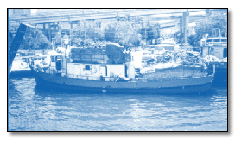 Vessels that have electronic circuitry
integrated into electro-mechanical steering, engine and anchor
system controls may experience sudden loss of response to inputs
if associated circuit board imbedded chips are not Y2K compliant.
Sudden loss of steering, engine and anchor system control, especially
while transiting congested waterways, could have catastrophic
results for both the vessel and others in close proximity. Marine
navigational and communications systems may likewise be affected
by the Y2K Dilemma. Vessels that have electronic circuitry
integrated into electro-mechanical steering, engine and anchor
system controls may experience sudden loss of response to inputs
if associated circuit board imbedded chips are not Y2K compliant.
Sudden loss of steering, engine and anchor system control, especially
while transiting congested waterways, could have catastrophic
results for both the vessel and others in close proximity. Marine
navigational and communications systems may likewise be affected
by the Y2K Dilemma.
SOLUTION: Vessel and waterfront facility owners and operators
should determine the degree to which their systems may be affected
by the Y2K dilemma.
Presently, the Coast Guard has focused on three critical Y2K
periods: September 9, 1999; December 30, 1999 to January 2, 2000;
and, February 29, 2000. During these periods, the maritime community
should expect to be under tighter controls by the Coast Guard
Captain of the Port.
| Ideally, manufacturers should be
asked to provide certification to the user that their equipment
is Y2K compliant. Alternatively, date-sensitive systems should
be tested by running the clock forward to December 31, 1999 to
see if failures in a controlled test will occur. The Coast Guard
has developed a risk assessment worksheet to determine the degree
of risk posed by vessels and cargo handling operations. The worksheet
differentiates by type of vessel, cargo carried, number of passengers
on board, waterway, weather condition, cargo handled, and degree
of Y2K compliance of critical control systems. If necessary,
the Coast Guard Captain of the Port will prohibit the passage
of vessels that score very high on the risk point scale. For
vessels that score lower in risk that want to make passage along
congested waterways, the |
|
Designated Waterfront Facility Inspections &
Discrepancies* |
|
1994/95: 4.0 Avg. per Inspection
1995/96 : 1.6 Avg. per Inspection
1996/97: 1.4 Avg. per Inspection
1997/98: 1.8 Avg. per Inspection
Since the QAT formation, the average number of discrepancies
found during inspections and spotchecks has decreased by 55%.
*Applies to 33 facilities on the Miami River
that handle hazardous goods/dangerous cargo.
|
|
Captain of the Port may insist on additional ship personnel
stationed at manual override stations for steering, engine control
and anchoring systems; escort by tugs; and passage in good weather
and daylight conditions only. Members of the maritime community
will be issued the risk assessment worksheet by way of a Captain
of the Port Marine Safety Information Bulletin as soon as the
worksheet is made available by Coast Guard Headquarters.
PROBLEM: Substandard cargo vessels continue to dominate
vessel examination activities.
The Caribbean Cargo Ship Safety Code (CCSSC) has had a great
impact on the Miami River community in that the Coast Guard is
seeing considerably fewer substandard vessels of less than 500
gross tons (GT). While in past years as many as 50 vessels at
any given time were on hold due to safety deficiencies on the
Miami River, today we see about half that number placed on hold.
However, cargo demands continue to increase unabated, and the
trend indicates a shift away from non-containerized cargo. Smaller
vessels (such as those traditionally seen on the Miami River)
may be decreasing in numbers, giving way to an increase in port
calls by vessels more capable of carrying containerized cargo
and achieving economies of scale (between 500 and 3,000 GT).
These vessels fall under the safety requirements set forth in
the International Convention for the Safety of Life at Sea (SOLAS),
resulting in a greater number of SOLAS detentions - which are
increasingly the lion's share of River deficiencies - on vessels
that frequent the Miami River.
However, a large fleet of non-SOLAS size vessels (those less
than 500 GT) remains on the River. The historic problems experienced
with these vessels could resurface or be further compounded if
trade opportunities between the United States and Cuba were to
become a reality. The need to serve an expanded market could
give rise to more Flags of Convenience (FOCs) established in
the Caribbean to cash in on the greater demand for tonnage. Furthermore,
the eventual world-wide shortage of high quality, small tonnage
(greater than 500 GT, less than 3,000 GT) vessels could result
in a return to more low quality vessels calling upon the Miami
River.
|