Miami River Quality Action Team
Annual Report 1998-1999
Marine Safety
|
SOLUTION: Increased targeting of problem vessels and industry
proficiency in SOLAS regulations and a continuing proficiency
in the CCSSC.
The Coast Guard has a fully implemented targeting system aimed
at identifying high risk vessels (those that pose a threat to
the environment, port safety, life and/or property). Those vessels
are placed under close Coast Guard scrutiny. Through the aggressive
pursuit of penalties, denials of entry for substandard vessels,
and the detention of those substandard vessels discovered in
port, an active deterrent is created. Additionally, the QAT's
industry outreach better informs and educates the maritime community
on the administration and means of compliance with existing and
new regulations.
PROBLEM: Poor maintenance of bridge lighting and poor communications
among vessel operators, bridge tenders and bridge owners pose
a significant threat on the Miami River waterway system.
The 1998 Quality Action Team heard numerous complaints about
the condition and operation of bridges, including concern over
navigational light outages, bridge curfews, and communication
problems between bridge tenders and vessel operators.
|
|
Miami River Bridges |
Operated by Private
Contractors for FDOT
N.W. 27th Avenue
N.W. 12th Avenue
N.W. 5th Avenue
Flagler Street
S.W. 1st Street
Brickell (or S.E. 2nd Ave.)
Operated by Miami-Dade County
N.W. South River Drive (or Tamiami)
N.W. 22 Avenue
N.W. 17 Avenue
S.W. 2nd Avenue
South Miami Avenue
Four Fixed Bridges
Metromover
Metrorail Rapid Transit
North-South Expressway
(Interstate 95)
East-West Expressway
(State Highway 836)
|
|
SOLUTION: Open dialogue between tugboat captains and bridge
owners to better focus on the safe movement of vessels through
the many bridges on the River; take necessary steps to resolve
dangerous conditions resulting from inadequate navigation lights
and communication problems; make sure that bridge tenders recognize
the five whistle emergency blast as having priority over bridge
curfews.
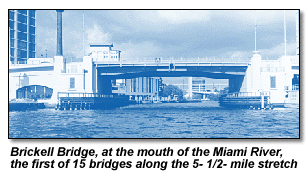 Numerous QAT meetings were devoted
to dealing with bridge problems. The Coast Guard Captain of the
Port, Coast Guard Bridge Administration and County and State
bridge owners worked together to thoroughly investigate each
complaint and enact solutions, agreeing to hold periodic meetings
to address present and future waterway issues. Numerous QAT meetings were devoted
to dealing with bridge problems. The Coast Guard Captain of the
Port, Coast Guard Bridge Administration and County and State
bridge owners worked together to thoroughly investigate each
complaint and enact solutions, agreeing to hold periodic meetings
to address present and future waterway issues.
The QAT notes that issues concerning navigational lights are
a constant problem. When lights are reported as inoperable, repairs
are expeditious. However, because lights are not monitored at
every shift of bridge tenders, the bridge owner and the Coast
Guard Bridge Division must rely on the waterway user to report
light outages. As a result, tugboat captains have agreed to keep
journals and report incidents for better monitoring of the situation.
Tugboat captains also expressed concerns about the difficulty
of bringing a large tow to a stop and holding in place when they
have missed the last passage of a bridge by a minute or two before
the curfew goes into effect. Because the Miami River bridge curfews
were put in place to relieve motoring congestion, waterway users
must plan to negotiate bridges during non-curfew hours. However,
federal regulations do allow emergency openings for vessels in
distress. If tugboat captains cannot safely stop their tow, thereby
placing themselves and the bridge in a distress condition, they
can signal the bridge by sounding five short blasts in rapid
succession. Under federal regulations, bridge tenders must respond
with an immediate opening upon a sounding of the five blasts.
The biggest problem on the Miami River System has been poor
communications between bridge tenders and vessel operators. This
issue focusses on the lack of response by bridge tenders to radio
communications from tugs, for several possible reasons. Inadequate
response may be due to broken radios, or the fact that radio
use is not a required element of bridge tender response procedure,
or to the bridge tender's and vessel operator's inability to
communicate in a common language. Vessel captains also complain
of bridge tender failure to warn ships about mechanical delays
up or down River which may force them to seek a temporary place
to lay-up while a bridge is being repaired.
When these problems were raised at the QAT, the Captain of
the Port and the Coast Guard Bridge Administration met with bridge
owners (representatives of the County and the State) to discuss
this particular issue at length. Resolutions to promote clearer
communications between bridge tenders and vessel operators are
being worked out, particularly through improved and increased
use of radio equipment. The Coast Guard and bridge owners are
also formulating procedures through which bridge tenders will
communicate with each other in order to advise vessel operators
of possible bridge delays throughout the River.
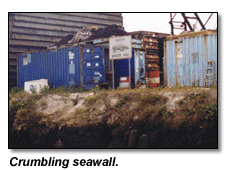 PROBLEM: Substandard mooring fixtures
and crumbling sea walls on facilities along the Miami River pose
a safety threat to facilities and vessels. In some places, there
are no seawalls. PROBLEM: Substandard mooring fixtures
and crumbling sea walls on facilities along the Miami River pose
a safety threat to facilities and vessels. In some places, there
are no seawalls.
Waterfront facilities on the Miami River have experienced
incidents in which undersized or wasted vessel mooring fixtures
have failed, resulting in damage to the facility, the moored
vessel and to other vessels in the vicinity. These incidents
have raised concern over the adequacy of mooring systems and
the structural integrity of waterfront facilities on the Miami
River.
SOLUTION: Conduct Visual Facility Surveys of all commercial
cargo ship facilities on the Miami River focusing on the adequacy
of vessel mooring fixtures.
In an effort to increase the overall safety of the Miami River,
the Coast Guard Captain of the Port is conducting visual facility
surveys of all terminal facilities on the Miami River. The intent
is to ensure that all facilities are adequate for the activity
and size of vessels that moor on the waterfront. Coast Guard
is looking principally at the adequacy of seawalls, bulkheads
and landside ship mooring fixtures.
If, during the course of the visual facility survey, apparent
deterioration of the general condition of both vessel mooring
system fixtures and waterfront land retaining structures are
observed, a Captain of the Port requirement will be issued under
the Ports and Waterways Safety Act (33 C.F.R. Part 160). The
owners/operators will be required to furnish an engineering analysis
or conduct a dynamic load test to show that suspect fixtures
are adequate in size and holding capability.
In addition, Coast Guard field personnel also engage in joint
agency visits with Department of Environmental Resources Management,
City of Miami Police Department, City of Miami Neighborhood Enhancement
Teams, City of Miami Fire Department, Miami-Dade County Team
Metro, Miami-Dade County Police Department and Miami-Dade County
Fire Department. These agency teams inspect waterfront facilities
for compliance with all federal, county and city safety requirements,
building codes, land uses and operating permit requirements.
|