Miami River Quality Action Team
Annual Report 1998-1999
Marine Safety
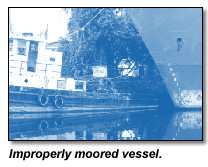 PROBLEM:
The Miami River as a port and waterway system continues to be
plagued by improperly attended and moored vessels. PROBLEM:
The Miami River as a port and waterway system continues to be
plagued by improperly attended and moored vessels.
Many commercial freight vessels moored on the River have been
found to be inadequately moored or have inadequate professional
mariner personnel on board to properly attend to the vessel.
In one notorious case involving M/V Rex Bear, the vessel, while
moored near the mouth of the Miami River, suffered the loss of
its stern mooring line when a passing dead ship tow caused the
vessel to surge against its moorings. Because of the severely
wasted condition of this derelict vessel, its stern mooring bit
was ripped from the deck plating resulting in the vessel's stern
swinging dangerously out into the channel of the River.
SOLUTION: Take aggressive regulatory measures to resolve
dangerous conditions if corrective measures are not immediately
and voluntarily taken by vessel owners or operators.
The Coast Guard Captain of the Port took immediate steps to
order Rex Bear relocated to a safe location. Even after the vessel
was moved to a secure spot, the River became plagued by a series
of pollution incidents involving Rex Bear. Had the vessel been
properly attended by an onboard qualified person, it is believed
these incidents would not have occurred.
After several months of interactions with the local agent
for the vessel's overseas owners, Rex Bear was donated to a local
sport fisher association which planned to sink the vessel under
Miami-Dade County's Artificial Reef Program. The vessel was towed
to the County's facility on the River and prepared for sinking
by Mr. Cliff Kunde of the Atlantic Gamefish Foundation under
the watchful eyes of field representatives of the County's Department
of Environmental Resources Management and the Coast Guard Captain
of the Port.
To prepare vessels for the artificial reef program, workers
must meticulously remove all oil pollutants, hazardous materials,
debris, and structural materials that could escape the vessel
in its sunken state and cause harm to the marine environment.
All hatches and doors are removed or welded open to allow easy
entry and exit by fish or SCUBA divers.
The Miami River QAT held its regular meeting on June 16, 1998,
while embarked and underway on the Coast Guard Auxiliary Vessel
Kingfisher. A prominent item on that meeting's agenda was to
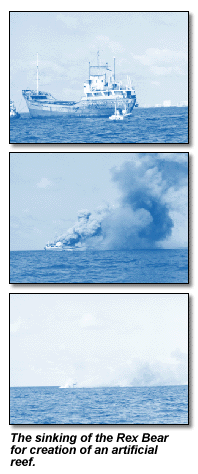
observe the sinking of Rex Bear. At 10:00 a.m. experts from the
Miami-Dade Police Department Bomb Squad detonated a series of
carefully placed charges that opened Rex Bear's hull to the sea.
Within minutes the vessel went safely to the bottom and to a
new productive life as an artificial reef.
 PROBLEM:
The Miami River, like the rest of South Florida, is in perennial
danger of being adversely and severely affected by hurricanes. PROBLEM:
The Miami River, like the rest of South Florida, is in perennial
danger of being adversely and severely affected by hurricanes.
South Florida sits directly in the general path of hurricanes.
A storm of serious strength striking the Miami River threatens
vessels, businesses and inhabitants located along the River with
sustained high winds, extremely heavy rainfall, tornadoes spawned
in the outer weather bands of the storm, storm tidal surge, and
high water resulting from storm water runoff from the Everglades.
Studies conducted by scientists of the National Hurricane Center
concluded that a storm of the duration and intensity of Andrew,
striking at the worst case position relative to the Miami River,
would result in significant damage to property and threat to
human life. The combination of storm produced hazards could cause
vessels to break their moorings and be wind-driven into other
vessels and bridge structures. Many vessels could sink in the
River. If this were to occur, the River would close to commerce
until the sunken vessels could be located and removed. Bridges
would not be usable by motorists, pedestrians or vessels until
structural and mechanical engineering surveys were completed
and damage repaired, resulting in a significant blow to local
and state economies.
SOLUTION: To the greatest extent possible, clear the River
of commercial vessels and missile hazards well in advance of
the storm's arrival.
When a storm begins to threaten the ports and waterways of
South Florida, Coast Guard port preparedness field teams fan
out through the area to warn commercial vessel and waterfront
cargo facility operators of the storm's potential for striking.
To minimize the impact to the port, commercial vessel masters
are warned they must depart U.S. waters of South Florida well
in advance of sustained storm force winds. Waterfront cargo facility
operators must secure all property to minimize the missile threat
created by wind-blown objects.
Owners, operators, masters or shipping agents of vessels not
capable of getting underway because of non-operational or materiel
condition must request permission from the Coast Guard Captain
of the Port to remain in port. Field personnel will visit the
vessel to verify the vessel's condition. Commercial vessels allowed
to remain in port through a storm must meet a strict set of requirements
including deployment and continuous tending of additional mooring
lines to properly sized and constructed land sidfixetures, and
fully manned bridge navigation and engineering plant watches
to control the vessel if moorings are broken. These arrangements
will be checked by Coast Guard patrol personnel to ensure the
master has taken adequate measures.
Coast Guard port preparedness patrols will commence their
visits to facilities and vessels when a storm having sustained
winds of tropical storm force or greater (39 miles per hour,
or 34 knots) may make landfall within 72 hours. At that point,
the Coast Guard Captain of the Port will set Storm Condition
4 Alert and issue a Broadcast Notice to Mariners warning of the
setting of this condition. Port preparedness patrols will be
conducted daily and Broadcast Notices to Mariners will be updated
in the event a storm continues to threaten the area. At 48 hours
before possible landfall, Storm Condition 3 will be set; at 24
hours before, Condition 2 will be set; and, at 12 hours before
possible landfall, Condition 1 will be set.
Commercial vessel masters will be warned to make for safer
waters well in advance of the storm's possible arrival. By the
time Storm Condition 2 is set, they must have departed unless
approved by the Coast Guard to remain in port because of non-operational
or serious materiel condition. At the setting of Storm Condition
1, all waterfront cargo handling operations should cease and
all facility items that could become missile hazards should be
properly secured inside buildings or lashed down. Vessel masters
and tug companies must also be aware that local authorities may
order the evacuation of coastal areas; this will have an impact
on the operation of bridges on the Miami River.
In addition, under an agreement between the Coast Guard and
the bridge owners, all River bridges will be locked down and
bridge tender personnel evacuated when sustained tropical storm
force winds are expected to make landfall within eight hours.
Vessel masters must make their departure from the River well
enough in advance of the storm for safe vessel passage, given
their operational speed and taking into account the limited numbers
of tugs available to service the River.
|