Miami River Quality Action Team
Annual Report 1998-1999
Environmental Protection
 PROBLEM:
Stormwater Runoff PROBLEM:
Stormwater Runoff
According to the Department of Environmental Protection, contaminated
stormwater runoff is the leading source of water pollution in
the State of Florida. Water quality in the Miami River is poor
compared to other portions of Biscayne Bay and its tributaries,
in part due to stormwater runoff. Pollutants from runoff limit
the full recreational and economic use of the Miami River and
also degrade the receiving waters of the Biscayne Bay Aquatic
Preserve. Contaminated stormwater runoff is not only an aesthetic
and economic problem, but also a problem affecting human safety,
water quality and populations of a vast number of organisms.
SOLUTION: Continue Stormwater Capital Improvement Projects
in the City of Miami and Miami-Dade County; maintain public education
efforts.
Through the Stormwater Utility Capital Improvement Project
Program, Miami-Dade DERM has taken on the task of retrofitting
storm drainage systems to maximize flood protection and minimize
the water quality and quantity impacts of stormwater runoff in
unincorporated areas and on County roads. A series of Stormwater
Utility Capital Improvement Projects are currently under design
or construction which, along with numerous local drainage projects,
will enhance the capacity of the existing drainage system in
routing stormwater to appropriate channels, after achieving compliance
with water quality regulations. Listed below is a brief description
of Capital Improvement Projects expected to impact the surface
waters of the Miami River and its tributaries.
 Control
Structure at NW 12 Avenue and NW 14 Street Morris Park Outfall
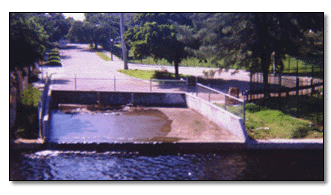
The objective of this project was to prevent further salt
intrusion into the Biscayne Aquifer by upgrading the existing
salinity control structure. In addition, the structure acts as
a weir device, controlling the stormwater runoff discharge to
the Seybold Canal. The project was constructed in 1995 at a cost
of $46,000. Control
Structure at NW 12 Avenue and NW 14 Street Morris Park Outfall
The objective of this project was to prevent further salt
intrusion into the Biscayne Aquifer by upgrading the existing
salinity control structure. In addition, the structure acts as
a weir device, controlling the stormwater runoff discharge to
the Seybold Canal. The project was constructed in 1995 at a cost
of $46,000.
Miami River Outfall Retrofit Basin 21 NW 22 Avenue,
from Flagler Street to the Miami River This project
will retrofit the existing stormwater drainage system to reduce
stormwater runoff contaminants. The existing system provides
minimal treatment. The intent of this improvement is to treat
the full first inch of runoff generally thought to be the
worst prior to any discharge. The project is under design
with an estimated cost of $650,000. A South Florida Water Management
District (SFWMD) grant to DERM has covered a portion of design
costs. The County is currently negotiating with the City of Miami
to obtain the necessary drainage easements for this project.
This construction project ranks as the number 7 priority basin
in the DERM Technical Report 88-2 (Calas, Valdes).
Miami River Outfall Retrofit Basin 23 NW 22 Avenue,
from NW 36 Street to the Miami River The objective
of this project is to reduce the stormwater runoff contaminants
entering the Miami River by providing treatment for the full
first inch of runoff prior to any discharge. The project design
is complete and the project is under construction. The total
estimated cost is $1,017,000. The SFWMD assisted with 50% of
the design cost, and has committed to 60% of the construction
cost. This project was identified as the number one priority
basin in the DERM Technical Report 88-2 (Calas, Valdes).
 Lawrence
Waterway Pollution Control Structure The construction
of a pollution control structure at the NW 7 Street drainage
system's discharge to the Lawrence Waterway is scheduled for
Fiscal Year 1999. The intent of the improvement is to control
or remove floatables and solids within the structure itself prior
to final discharge to the canal. The Lawrence Waterway improvement
is estimated to cost $61,000. This project is included in the
priority list of the Quality Neighborhood Improvement Bond Program,
and will be financed through the Stormwater Utility Revenue Bond
Series 1999. Lawrence
Waterway Pollution Control Structure The construction
of a pollution control structure at the NW 7 Street drainage
system's discharge to the Lawrence Waterway is scheduled for
Fiscal Year 1999. The intent of the improvement is to control
or remove floatables and solids within the structure itself prior
to final discharge to the canal. The Lawrence Waterway improvement
is estimated to cost $61,000. This project is included in the
priority list of the Quality Neighborhood Improvement Bond Program,
and will be financed through the Stormwater Utility Revenue Bond
Series 1999.
DERM is involved in many public education projects intended
to increase awareness about stormwater issues. Because the basin
that drains to the Miami River covers an area of 69 square miles,
the public must be apprised that trash on the streets within
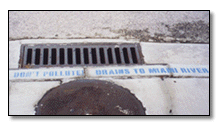
the basin eventually ends up in the River. A stenciling program
placing reminder messages at drains discharging to the River
provides an effective tool to achieve this education at key sites
within the basin.
PROBLEM: Harmful Human Impact on Manatees
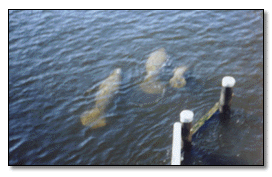
The Miami River is an important habitat for the Florida manatee
in Miami-Dade County, providing freshwater and a refuge during
cold weather. The animals are observed in the River and its tributaries
year-round. Many travel to Biscayne Bay seagrass areas outside
the Miami River to feed. Others prefer freshwater areas upstream
of the floodgates during warm weather. Due to the mild winters
in 1998 and 1999, manatees were regularly observed in the freshwater
portion of Tamiami Canal and the lakes south of Miami International
Airport.
Manatees face many dangers in the Miami River and its tributaries,
including crushing in floodgates, vessel collisions, and entrapment
in drainage structures. In 1998 through June 1999, 15 manatee
carcasses were recovered in Miami-Dade County, including three
in the Miami River watershed upstream of the floodgates.
 SOLUTION:
Floodgate modification, Fender Systems, increased Enforcement
and continued Public Education SOLUTION:
Floodgate modification, Fender Systems, increased Enforcement
and continued Public Education
A manatee protection device was installed in the floodgate
system on the Miami River in 1997 and on Tamiami Canal in 1998.
A piezo-electric sensor triggers a closing gate to reverse direction
and reopen when a live animal is detected. These devices have
thus far proven effective at eliminating manatee deaths in the
floodgates.
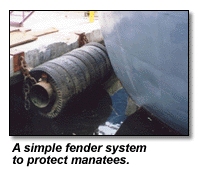
Ship terminals and other facilities providing mooring for
large vessels are required to install fender systems to prevent
manatees from becoming crushed between a vessel hull and a bulkhead.
Almost all facilities in the Miami River have come into compliance
with this condition in the MOPs (marine facility operating permits)
issued by DERM.
Several law enforcement agencies monitor vessel speed restrictions
in the Miami River and Blue Lagoon freshwater lake system around
Tamiami Canal, which helps to protect manatees from vessel collisions.
The City of Miami Police and Marine Patrol, U.S. Coast Guard,
and Florida Game and Freshwater Fish Commission have been especially
active in this capacity. Additionally, the QAT regularly bolsters
manatee awareness in its Miami River Annual Report.
|