Miami River Quality Action Team
Annual Report 1998-1999
Environmental Protection
 Traditionally,
Miami-Dade's Department of Environmental Resources Management
(DERM) has taken a strongly proactive role on issues affecting
the water quality, habitat, and general environment of the Miami
River. For many years, Miami-Dade County also served as the informal
sponsor of the Miami River dredging effort. While the leadership
of the dredging effort has recently been undertaken by the Miami
River Commission, DERM is still an active participant of the
MRC Dredging Committee, the Miami River QAT and the Miami River
Enforcement Group. While the environmental health of the Miami
River depends upon the cooperation and dedication of all Miami
River entities neighborhoods, businesses, and a host of
agencies (Coast Guard, Florida's DEP and the EPA, among others)
DERM continues to exercise high visibility and strong enforcement
on the Miami River. Traditionally,
Miami-Dade's Department of Environmental Resources Management
(DERM) has taken a strongly proactive role on issues affecting
the water quality, habitat, and general environment of the Miami
River. For many years, Miami-Dade County also served as the informal
sponsor of the Miami River dredging effort. While the leadership
of the dredging effort has recently been undertaken by the Miami
River Commission, DERM is still an active participant of the
MRC Dredging Committee, the Miami River QAT and the Miami River
Enforcement Group. While the environmental health of the Miami
River depends upon the cooperation and dedication of all Miami
River entities neighborhoods, businesses, and a host of
agencies (Coast Guard, Florida's DEP and the EPA, among others)
DERM continues to exercise high visibility and strong enforcement
on the Miami River.
Early in 1998, DERM determined that its program effectiveness,
efficiency and productivity could be improved by eliminating
program overlap and duplication of staff effort. For example,
a boatyard might be visited by several inspectors to check permit
compliance for marine facility management, industrial waste management,
air quality or underground tanks, yet different inspections are
required if the boatyard needs to repair docks or bulkheads.
Still another group of staff checks for environmental compliance
and follows up on enforcement issues. As a result, several programs
were consolidated to form a new Miami River management group
within DERM.
 The newly
organized team is part of the Coastal Resources Section in the
Natural Resources Division. The team focuses on permitting and
enforcement in the Miami River watershed, and continues to implement
the marine facilities operating permit program (the MOPs). The
Miami River team also oversees grants for derelict vessel removal
and Wagner Creek enforcement. This approach is expected to reduce
duplicative or even contradictory requirements, and enhance the
working relationship of the department and the regulated community.
DERM's Miami River management team regularly reports on environmental
protection to the QAT. The newly
organized team is part of the Coastal Resources Section in the
Natural Resources Division. The team focuses on permitting and
enforcement in the Miami River watershed, and continues to implement
the marine facilities operating permit program (the MOPs). The
Miami River team also oversees grants for derelict vessel removal
and Wagner Creek enforcement. This approach is expected to reduce
duplicative or even contradictory requirements, and enhance the
working relationship of the department and the regulated community.
DERM's Miami River management team regularly reports on environmental
protection to the QAT.
PROBLEM: Abandoned or derelict vessels continue to appear
on the Miami River, posing navigational and/or environmental
hazards, despite ongoing and successful removal efforts.
Derelict vessels continue to cause environmental and navigational
problems on the Miami River and its tributaries. Often derelict
vessels may contain substances on board that, once discharged
to the waters of the Miami River, become pollutants and add to
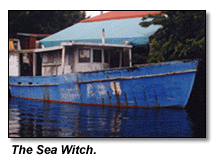
contaminated sediments. News reports in the early summer of 1999
attributed a seven-mile oil spill to the derelict Sea Witch,
which sank before it could be removed.
 SOLUTION:
Continue the current Derelict Vessel Removal program operated
by the Florida Marine Patrol (FMP) and DERM. Continue the QAT
search to improve options for prompt removal, including establishment
of a dedicated funding source, strengthening local mooring codes,
and enhancing local authority to remove abandoned vessels. Educate
the public that derelict vessels should be reported immediately
to the Florida Marine Patrol at (305) 795-2145. SOLUTION:
Continue the current Derelict Vessel Removal program operated
by the Florida Marine Patrol (FMP) and DERM. Continue the QAT
search to improve options for prompt removal, including establishment
of a dedicated funding source, strengthening local mooring codes,
and enhancing local authority to remove abandoned vessels. Educate
the public that derelict vessels should be reported immediately
to the Florida Marine Patrol at (305) 795-2145.
The Florida Marine Patrol tracks derelict vessels as part
of the state's Derelict Vessel Program. When a vessel is reported,
the FMP then inspects it to determine if the vessel is indeed
derelict. The FMP then attempts to identify the owner to order
removal. Identified vessel owners who ignore FMP orders are subject
to penalties, arrest and prosecution.
Because of the agency's rigorous search for vessel owners
and its ability to seek penalties, the FMP has successfully forced
owners of abandoned vessels to remove them, saving taxpayers
tens of thousands of dollars. If ownership is impossible to determine,
the vessel is placed on a list maintained by the FMP for vessel
removal. The FMP has dedicated a law enforcement officer exclusively
to enforce derelict vessel regulations and accelerate the administrative
steps related to documenting derelict vessels.
Funding for removal of derelict vessels comes from the Florida
Derelict Vessel Removal Program and the Florida Inland Navigation
District. In the latter part of 1998, Miami-Dade County was awarded
$78,500 to remove more than 40 derelict vessels from County waters,
including 15 from the Miami River. In a revised contractual process
encouraged by the QAT, listed vessels are now grouped in geographic
areas for greater cost effectiveness and efficiency of removal,
in the hopes of speedier removal. The QAT will continue to assess
options to eliminate the problem of derelict vessels.
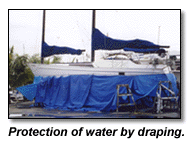 PROBLEM:
How to involve the marine community and marine facilities in
creating and implementing Best Management Practices. PROBLEM:
How to involve the marine community and marine facilities in
creating and implementing Best Management Practices.
SOLUTION: Continue support for the Marine Facilities Annual
Operating Permit Program and the Marine Facilities Advisory Committee
from the QAT and marine community.
Implemented in 1990 by Ordinance 89-104, DERM's Marine Facilities
Program regularly inspects more than 85 permitted facilities
on the Miami River and its tidal tributaries. These facilities
include shipping terminals, boatyards, boat repair facilities,
recreational docking facilities, commercial salvage and fishing
operations and boat manufacturers. The Marine Facilities Best
Management Practices (BMPs) were developed by the program in
concert with the Marine Facilities Advisory Committee and serve
as guidelines for day to day operations to promote "good
housekeeping" practices.
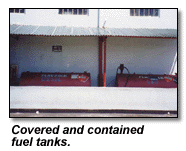
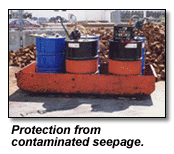
Examples of BMPs include the segregation and proper disposal
of wastes such as oil, fuel, solvents and waste paint; the maintenance
of sewage pumpout systems for vessels; and control techniques
for pressure cleaning, bottom paint removal, sand blasting or
spray painting. Compliance with BMPs reduces pollution and allows
facilities to minimize wastes generated from various processes
performed on site.
 Miami-Dade
County's annual celebration of Biscayne Bay, Baynanza, also encourages
public stewardship for the Miami River. As part of Baynanza '99,
volunteers assist in the clean up of three sites along the shores
of the Miami River: Jose Marti Park, Sewell Park and Curtiss
Park. More than 100 volunteers participated in this year's event.
Everything from automobile tires, lumber, plastics and shopping
carts were removed from the shoreline's public parks under this
volunteer program. Organizers will continue to seek ways to expand
Baynanza to other sites along the Miami River. Miami-Dade
County's annual celebration of Biscayne Bay, Baynanza, also encourages
public stewardship for the Miami River. As part of Baynanza '99,
volunteers assist in the clean up of three sites along the shores
of the Miami River: Jose Marti Park, Sewell Park and Curtiss
Park. More than 100 volunteers participated in this year's event.
Everything from automobile tires, lumber, plastics and shopping
carts were removed from the shoreline's public parks under this
volunteer program. Organizers will continue to seek ways to expand
Baynanza to other sites along the Miami River.
|