Miami River Quality Action Team
Annual Report 1996-1997
Enforcement
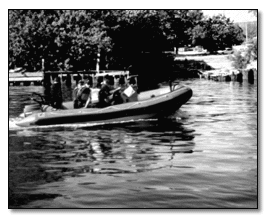 The 1997 Miami River Quality Action
Team identified the single greatest problem of enforcement as
limitations of agency resources in staff and funding. A creative
combination of continued efforts, new initiatives and proposed
future measures are planned to cover existing shortfalls. The 1997 Miami River Quality Action
Team identified the single greatest problem of enforcement as
limitations of agency resources in staff and funding. A creative
combination of continued efforts, new initiatives and proposed
future measures are planned to cover existing shortfalls.
On-Going Efforts
PROBLEM: "Impromptu facilities" and waterfront
facility safety.
Numerous waterfront facility operators on the Miami River
serve as the gateway for the export of general cargo, vehicles,
food products, fuel and hazardous materials. Because of the transient
nature of many of these facilities, noncompliance with federal,
state, and local regulations has historically been a problem.
In 1997, several property owners began receiving ships and cargo
at properties which were marginally developed and could only
loosely be described as marine terminals. Occasionally ocean-going
vessels could be seen moored to nothing more than a tree. These
"impromptu facilities" were not fully in compliance
with federal, state and local safety and permitting requirements.
|
SOLUTION: Multi-agency inspection activities.
Several impromptu facilities were the targets of joint multi-agency
inspections and compliance audits by the Coast Guard, Florida
Department of Environmental Protection, Dade County Environmental
Resource Management, City of Miami Downtown NET, and local police
and fire departments. Multi-agency inspections offer a streamlined,
unified approach that benefit waterfront facility operators and
regulatory agencies alike.
|
| Illegal Drugs,
Aliens and Merchandise |
Cocaine : 4,425 lbs. (9 Arrests)
Stolen Cars: 58 Recovered
Illegal Aliens : 421
Public information seizures by one agency alone, U.S.
Customs, for 1996-97.
|
|
From a regulator's standpoint, they result in increased interagency
cooperation, cross training, and efficiency by serving as a force
multiplier for scarce enforcement resources. Facility operators
benefit from the unified, consistent enforcement by federal,
state and local agencies with sometimes concurrent jurisdiction.
As in the past, using equal doses of education and enforcement,
the QAT has continued to achieve great success in bringing waterfront
facilities into compliance with federal and local regulations.
The State Attorney's Crime Stoppers Program
Described in greater detail on page 7 of this report, the
Crime Stoppers program encourages citizen reporting of environmental
crimes by establishing rewards for the arrest and filing of charges
against perpetrators. The Crime Stoppers number is 471-TIPS.
New Innovations
PROBLEM: Riverside security and jurisdictional issues involving
enforcement and regulatory agencies.
The Miami River has long been an area of inbound smuggling
of narcotics from vessels which visit from the Caribbean and
Central and South America. In addition to the inbound threat,
the river is affected by a significant outbound threat. The illegal
shipments of stolen vehicles and cargo from the river to the
Caribbean and the Americas represents a significant problem.
While there have been enforcement operations, some fairly significant
in scope, they have been single jurisdictional for the most part.
SOLUTION: U.S. Customs intiative,
the Miami River Project.
The Miami River project is a multijurisdictional consortium
of law enforcement agencies working in coordination with federal,
state and local regulatory agencies to conduct combined enforcement
operations that will address crime and the quality of life issues
affecting South Florida and the Miami River. Begun in the Fall
of 1997, the Project allows enforcement entities to share intelligence
and resolve or refer jurisdictional issues instantly, thus enhancing
law enforcement capabilities. Two operations conducted in October
and December of 1997 netted impressive results in recovering
stolen cars and the discovery of illegal drugs and immigrants
hidden among bulk cargo.
Participants in the Miami River Project include U.S. Customs
Service Offices of Investigations and Field Operations; U.S.
Immigration Service; U.S. Border Patrol; Miami-Dade Police Department's
Multi-Agency Auto Theft Task Force and Miami-Dade Police Cargo
Theft Investigations; and the City of Miami Police Department.
Participating agencies maintain communication with the Miami
River Quality Action Team and the Miami River Enforcement Group
to enlarge the community's involvement in river enforcement activities.
Health and safety issues are referred to the U.S. Coast Guard's
Office of Marine Safety, the U.S. Environmental Protection Agency,
the Florida Marine Patrol, the Florida Department of Environmental
Protection and Miami-Dade's Department of Environmental Resources
Management. The newly created Miami River Hotline will assist
in referral of these calls.
|