Miami River Quality Action Team
Annual Report 1996-1997
Envrionmental Protection
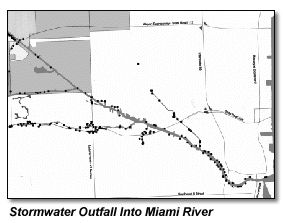 PROBLEM: Abandoned or derelict
vessels. PROBLEM: Abandoned or derelict
vessels.
Abandoned or derelict vessels cause navigational and environmental
problems on the Miami River. As vessels deteriorate, material
on board - including hazardous compounds - breaks down and disintegrates
into the water. Residues of oils and fuels become pollutants
in the water column and sediment. Corroding metal and debris
contribute to the problem, as do the vessel's attraction for
mosquitos and rats, creating a public health hazard.
SOLUTION: Streamline documentation and removal, maximize
funding resources, evaluate amendments to local mooring codes.
Abandoned or derelict vessels should be reported immediately
to the Florida Marine Patrol (FMP) at (305) 795-2145. The Florida
Marine Patrol locates and documents abandoned, sunken and derelict
vessels as part of the state's Derelict Vessel Program. Upon
notification, the FMP will inspect said vessel(s) and attempt
to locate the owner to effect removal. Identified vessel owners
who ignore FMP orders may be subject to arrest and prosecution.
Vessels without documented owners will be included in the list
of derelict vessels maintained by the FMP.
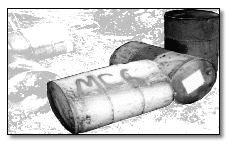 Funding for removal of derelict
vessels has been provided by grants from the Florida Derelict
Vessel Removal Program, administered by FDEP, and the Florida
Inland Navigation District. Local matching funds and services
have been contributed by Miami-Dade County and the City of Miami.
In 1997, DERM disbursed more than $97,000 in state and local
funds for the removal of more than 50 vessels from county waters,
including 17 from the Miami River. In early 1998, the County
will request competitive bids for removal of approximately 40
more vessels designated by the FDEP as derelict. The listed vessels
will be grouped by geographic area to encourage more cost effective
and efficient removal. By dedicating a law enforcement officer
exclusively to enforcement of derelict vessel regulations, the
Florida Marine Patrol has streamlined administrative steps related
to documenting abandoned vessels and successfully required owners
to remove vessels, saving taxpayers tens of thousands of dollars.
The Miami River Study Commission and QAT are assessing several
options for dealing with derelict vessel removal including strengthening
local mooring codes, enhanced local authority for removing abandoned
vessels, and establishment of dedicated funding sources. Funding for removal of derelict
vessels has been provided by grants from the Florida Derelict
Vessel Removal Program, administered by FDEP, and the Florida
Inland Navigation District. Local matching funds and services
have been contributed by Miami-Dade County and the City of Miami.
In 1997, DERM disbursed more than $97,000 in state and local
funds for the removal of more than 50 vessels from county waters,
including 17 from the Miami River. In early 1998, the County
will request competitive bids for removal of approximately 40
more vessels designated by the FDEP as derelict. The listed vessels
will be grouped by geographic area to encourage more cost effective
and efficient removal. By dedicating a law enforcement officer
exclusively to enforcement of derelict vessel regulations, the
Florida Marine Patrol has streamlined administrative steps related
to documenting abandoned vessels and successfully required owners
to remove vessels, saving taxpayers tens of thousands of dollars.
The Miami River Study Commission and QAT are assessing several
options for dealing with derelict vessel removal including strengthening
local mooring codes, enhanced local authority for removing abandoned
vessels, and establishment of dedicated funding sources.
PROBLEM: Dredging contaminated sediments.
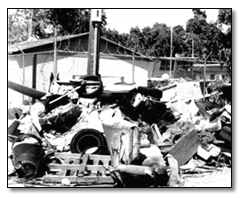
Sediment in the main shipping channel poses a serious threat
to the future viability of the Miami River. The sediments do
not meet federal criteria for ocean disposal, thus making the
cost of maintenance dredging prohibitive.
Because the sediments are contaminated, they pose an environmental
hazard. New studies conducted by NOAA and FDEP have confirmed
that sediments from throughout the River cause significant toxicity
in bioassay tests, and that sediments in adjoining parts of Biscayne
Bay are also toxic. This reinforces concerns that the contaminated
sediments in the River represent an environmental threat to portions
of the Bay.
Contaminants have accumulated in the sediment over many decades,
and have historically entered the river through point and non-point
sources. While efforts are underway to reduce and eventually
eliminate continuing pollution, the contaminated sediments represent
a continuing impact to the environmental value of the Miami River
and limit its full economic potential.
 SOLUTION: Evaluate alternative
disposal and treatment methods, secure favorable cost-share,
and assess phased dredging plan. SOLUTION: Evaluate alternative
disposal and treatment methods, secure favorable cost-share,
and assess phased dredging plan.
The U.S. Army Corps of Engineers has continued to evaluate
disposal and treatment alternatives that could reduce the cost
of maintenance dredging. The Corps is assessing methods and cost
effectiveness of segregating the fine-grained sediments, which
generally contain most of the pollutants, from coarser materials.
Further testing would be required to determine if any of the
resulting material would be clean enough to use for construction
or filling. Miami-Dade County, which continues to serve informally
as a non-federal sponsor, and other local interests have focused
on securing a favorable cost-sharing formula and development
of a plan for a phased dredging project.
Problem: Human impact on manatees.
The endangered West Indian manatee occurs year round in Miami-Dade
waters, but is most abundant in winter. Like other canals and
tributaries, the Miami River is an important manatee habitat,
providing freshwater and refuge in cold weather. Manatees regularly
move between seagrass feeding areas in Biscayne Bay and the upstream
portions of the River. Unfortunately, manatees face many dangers
in the River area including crushing in water control structures,
vessel collisions, entrapment in drainage structures, and other
human impacts. In 1997, 14 manatees died in Miami-Dade County,
including three in the Miami River watershed upstream of water
control structures.
|